A coaching client who disengages quietly is the most expensive thing in a coaching business, and almost no coach catches it in time. The client signs, shows up to the first session enthusiastic, attends the next two, then misses one with a polite reason. The week after that the check-in message goes unanswered. By month three the coach is sending follow-ups into silence, and by month four the client churns with a vague thank-you. The coach loses the renewal, the referral, and the case study. The client loses the outcome they paid for. Both lose, and neither saw it happen in time.
A client accountability system for coaches is the layer that fixes this. Not a louder reminder, not a nag schedule, not a gamification gimmick. A working system catches disengagement early, keeps clients moving between sessions, surfaces the right context to the coach before each call, and quietly preserves the relationship that pays for itself in retention and referrals. Done well, it reframes accountability from "coach pestering client" to "system holding the structure of the programme so the client can focus on the work".
This post is the engineering view of how to build that system for a high-ticket coaching practice. What it actually contains, the check-in sequence we deploy, the architecture underneath, the failure modes, and the principles that keep automated check-ins feeling like the coach paid attention rather than a CRM ping. Written for coaches running £1k to £10k programmes who care about completion rates and lifetime value as much as new client acquisition.
What an AI client accountability system actually is
An AI client accountability system is the operational layer that runs between coaching sessions. Its job is to keep the client engaged with the programme they paid for, surface progress and friction to the coach, and intervene early when the client starts to drift. Every part of that work that does not need the coach's judgement gets handled by the system. Every part that does need the coach gets routed to them with the right context, at the right moment.
The traditional version of accountability is a coach with a calendar and willpower, sending check-in messages by hand, trying to remember which client was working on what, and noticing too late that someone has gone quiet. The automated version is a continuous loop that fires on a cadence, reads the client's actual behaviour (replies, completed actions, session attendance, sentiment in messages), and only escalates to the coach when something in the data warrants attention.
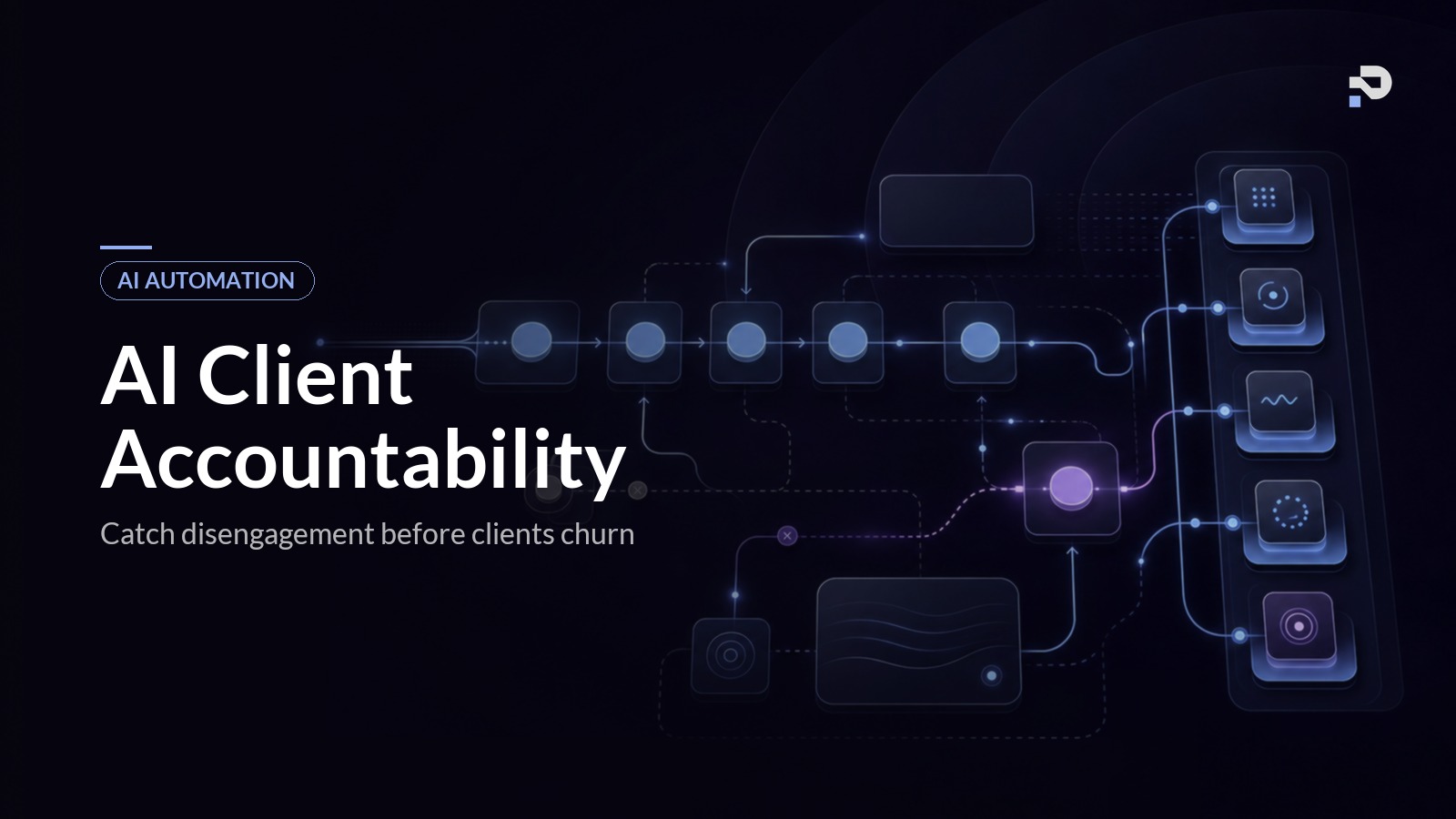
A working accountability system has five components running together:
- A check-in cadence that fires automated nudges on a schedule the client agreed to at signup.
- A progress capture layer that records what the client has done since the last session, structured and stored.
- A sentiment and engagement signal that detects when a client is going quiet or struggling.
- A pre-session brief generator that hands the coach the right context before every call.
- A coach-touchpoint layer that pulls the coach in at the moments their personal attention moves the needle.
If you build only the cadence and stop there, you have automated reminders. You do not have accountability. The reason most coaching CRMs feel insufficient at this is that they ship the cadence and skip the rest. The discipline is in running all five components together so the system carries the structural load while the coach's attention stays reserved for the moments that actually need it.
Why accountability is a retention engine, not a nice-to-have
Most coaches think of accountability as a delivery feature. The client paid for it, so the programme has to include it. Necessary, occasionally annoying, vaguely the coach's job to chase. This framing is the reason accountability gets reduced to a Sunday-evening reminder email in most coaching businesses, and it is the reason the same coaches lose half their clients between month three and month six.
The reframe is sharper. Accountability is the mechanism that makes the outcome happen, and the outcome is what justifies the price tag. A high-ticket coaching client who completes the programme and gets the result becomes a renewal, a referral, and a testimonial. A client who disengages quietly becomes a quiet churn, a refund risk, and a lost word-of-mouth opportunity. The economics of a coaching business sit downstream of how well clients are held to the work between sessions, and that work is where most manual systems fail.
The data supports this directly. In coaching engagements we have built systems for, the clients who completed weekly check-ins consistently across the first eight weeks renewed at materially higher rates than the clients who skipped them. The first thirty days after onboarding predict completion more strongly than any single coaching skill. Coaches who automate the check-in cadence (so it fires reliably regardless of how the coach's week is going) see fewer silent disengagements and stronger retention. The cost of weak accountability is not measured in the awkward feeling of unanswered messages. It is measured in the lifetime value lost on every client who fades out before the renewal conversation.
The other reason this matters: accountability scales worse than almost any other delivery component. A coach with five active clients can hold the structure in their head. A coach with twenty cannot, and the gap between five and twenty is the growth path most coaches are trying to walk. Coaches typically come to us drowning in mid-programme admin around the time they cross fifteen active clients. The system we build keeps the structure intact at thirty, fifty, or a hundred active clients, and the coach's actual coaching capacity scales because the operational layer is not stealing from it any more.
What gets automated, and what stays human
The same anxiety that comes up with discovery call automation and onboarding is in play here. The coach worries that automated check-ins will feel like a SaaS product ping, the client will start ignoring them, and the relationship will degrade. This is a real risk, and it shows up immediately when the automation is built without restraint.
The fix is to be precise about which moments the system handles and which moments stay human. We deploy three principles across every accountability build, and they have held up across coaching engagements with very different cadences.
The first principle is that the cadence is automated, the content is specific. A generic "How are you progressing this week?" sent on a schedule trains clients to ignore the messages within a fortnight. A check-in message that references the actual goal the client is working on this month, names the specific action they committed to in the last session, and asks one question the coach genuinely wants the answer to is read, replied to, and acted on. The AI layer reads the session transcript, the previous check-in, and the client's stated goal, then writes the message in the coach's voice. The cadence is mechanical. The content is not.
The second principle is that the coach appears for sentiment, not for schedule. Routine check-ins (Did you do the thing? How is it going? What is blocking you?) are handled by the system. The coach gets pulled in when something in the data warrants their attention, a missed action two weeks running, a tone shift in the client's replies, a no-show, a long gap of silence. The coach sends one personal message at exactly the right moment instead of fifteen routine ones nobody needed. The clients who get a personal message from the coach experience it as the coach noticing, because the coach actually did notice, with the system handling the watching.
The third principle is that the system removes structure from the client's mental load, not adds to it. A common mistake is treating accountability as an opportunity for the coach to demand more from the client. Daily check-in forms, weekly reflection prompts, monthly review documents, quarterly progress audits. This signals to the client that the coach has organised themselves, but it puts the structural cost on the client, which is precisely backwards for a high-ticket programme. Premium accountability feels light on the client side and complete on the coach side. The system carries the structure. The client does the work.
A system built on these principles does not feel like a chatbot or an automated drip. It feels like a coach who runs a tight, professional practice. Clients on systems we have built consistently report that the structure of the programme felt clear and that they stayed on track without feeling chased. They are not detecting automation. They are detecting that the coach has built a real operating system around their work.
The check-in sequence we deploy
This is the part of the post that exists almost nowhere else for this keyword. Most accountability content stops at the conceptual level or recommends a specific tool. The thing coaches actually need is a concrete sequence, with cadence and rationale. What follows is a paraphrased version of the loop we deploy in Praxail builds, tuned across coaching engagements with different programme lengths and intensities. Treat it as a starting blueprint, not a template to copy verbatim, since the right cadence depends on your offer.
Daily nudge (only where the programme calls for it)
For programmes where daily action matters (fitness, sales, sobriety, habit-formation coaching), the system fires a short nudge at a time the client chose at signup. Not "Did you do your workout today?" but a one-line, specific prompt referencing the action the client committed to this week. The reply is captured automatically (one tap, one short sentence, or a yes/no) and stored against the client's record. If the client misses two consecutive days, the system flags it.
Most high-ticket coaching programmes do not need a daily nudge. The temptation to add one because it feels active is strong and worth resisting. The right cadence for a strategic business coaching programme is weekly, not daily. The wrong cadence makes the messages background noise.
Weekly check-in
The weekly check-in is the load-bearing automation in the entire sequence. It fires on the day and time the client agreed to at signup (most often Sunday evening or Monday morning), and it asks two or three questions tailored to the client's current focus. The AI layer drafts the message using the previous session transcript, the client's stated goal, and any context from the last week's interactions. The coach has approved the voice and the structure once. The system writes each message specifically.
The reply lands in the system, gets parsed, and feeds into the pre-session brief. The coach reads structured replies for ten minutes before each call instead of trying to remember what each of fifteen clients said in disorganised inboxes. If a client's reply contains language the system flags as concerning (frustration, doubt, hints of disengagement), the coach gets a short notification with context.
The week any client does not reply, the system sends one soft follow-up the next day, then escalates to the coach for a personal touch on day three. We have found this three-step cadence (system, system, coach) catches disengagement reliably without the coach getting paged for every routine slow reply.
Pre-session brief
Before every call, the system generates a structured brief for the coach. It contains the client's goal, the actions agreed at the last session, what the client reported in the weekly check-in, any sentiment flags, the client's progress against the programme arc, and one line summarising what the coach should pay attention to in this session. The brief is generated automatically about an hour before the session.
The coach walks into the call already informed. Instead of spending the first ten minutes catching up, the session opens with the coach asking a sharper question because they already know the context. The client experiences this as the coach being on top of their case, which they are, because the system has done the operational work that makes that possible.
Sentiment and silent client catch
This is the failure-mode catch that separates a real accountability system from a reminder schedule. The system reads every reply, every missed check-in, every cancelled session, and every long gap of silence. It scores each client weekly on engagement (replies, completed actions, session attendance) and sentiment (tone, hesitation, frustration markers in their messages). When a client crosses a threshold, the coach gets a flagged notification.
We have seen this single component prevent more silent churn than any other piece of the system. Clients who would have faded out by month four get caught at week six, and a single short personal message from the coach at exactly that moment puts the relationship back on track. The coach does not need to be watching every client all the time. The system watches. The coach intervenes.
Quarterly progress review
At programme milestones (every twelve weeks, or whatever cadence fits the programme arc), the system pulls together a structured progress review. It contains the client's stated goals, the measurable progress against them, completed milestones, outstanding actions, and a written summary the AI layer drafts from the full history of check-ins and session transcripts. The coach reviews and adjusts in five minutes, then the review is shared with the client as a personal note from the coach.
This is the highest-leverage moment in the whole loop. A client who receives a structured progress review every quarter feels seen, sees their own progress in concrete terms (which is often invisible to them mid-programme), and is materially more likely to renew. The review is generated automatically from data the system has been collecting all along. The coach contributes judgement, not data assembly.
This loop, run continuously, takes a coaching business from "the coach holds it together with willpower" to "the system holds the structure and the coach does the coaching". It is exactly the system we ship as part of a Praxail client accountability build. The whole point is that the coach's attention is preserved for moments where it counts, and the operational load on both sides goes down.
Architecture notes for each component
The check-in sequence is the surface of the system. The architecture underneath is what makes it run reliably across dozens of clients without the coach getting paged or the messages going stale.
The cadence engine has to anchor on each client's individual programme start date and chosen check-in window, not a global schedule. We have seen coaches try to send all weekly check-ins on Sunday evening, which clusters all the replies on Monday morning and makes the brief generation fragile. The cleanest setup uses the workflow tool (Make, n8n, Zapier) to trigger per-client cron jobs based on each client's signup date and stated preference. The cadence respects the client's life, not the coach's calendar.
The progress capture layer has two design rules. Capture replies in structured form, not free text dumped into an inbox. And store everything against the client's record so the AI layer can read the full history. Inbox-based capture is the failure mode that turns a system into a chore. Structured capture (replies parsed into fields, stored in the CRM, exposed to the AI layer) is what makes pre-session briefs and sentiment detection possible. We use Notion or Airtable as the structured store for most coaching builds.
The sentiment signal is the part most coaches under-build. A working sentiment layer reads every client message, scores tone and engagement, tracks the trend across weeks, and flags clients whose engagement is declining. This is concrete signal work, not magic: reply length, reply latency, sentiment polarity, frequency of negative language, missed actions, missed sessions. Built well, the layer flags a struggling client two to three weeks before the coach would have noticed manually.
The pre-session brief generator is the component that delivers the most visible win for the coach. The brief should be generated about an hour before each session, based on the client's goal, last session transcript, weekly check-in replies, sentiment flags, and progress against milestones. The format matters. A good brief is one screen long and written so the coach can scan it in two minutes.
The coach-touchpoint layer is the discipline of editing rather than writing. The coach appears at flagged moments (sentiment dip, missed actions, milestone reviews, programme transitions), and the appearance is short and specific. A coach who tries to appear personally on every check-in ends up doing the same manual accountability they were trying to escape. A coach who designs touchpoints with restraint ends up with a system where their attention is reserved for moments that actually move retention.
Common mistakes coaches make automating accountability
Coaches who build this themselves usually trip on the same things.
Treating it as reminders rather than a system. A weekly automated reminder is not a client accountability system for coaches. It is the lightest layer of one, and on its own it does almost none of the work. Without progress capture, sentiment detection, the brief, and the coach-touchpoint layer, the reminders quickly become noise the client tunes out.
Generic check-in messages. A copy-paste "How is everything going?" sent every Sunday is the most common signal to the client that they are one of many. Personalisation has to be specific (referencing the actual goal and last session) to be felt. Generic messages train the client to ignore them, which is worse than not sending them.
Inbox-based progress capture. Letting client replies pile up in the coach's email is how data dies. The system has to parse and store replies in a structured way the coach (and the AI layer) can use. Otherwise the data has been collected for nothing.
No silent-client catch. Clients disengage quietly. Without sentiment and engagement scoring flagging the ones who have gone quiet at week six, the coach finds out at the missed renewal conversation in month four. Build the catch.
Daily check-ins where weekly is appropriate. The instinct to demonstrate care through frequency produces overwhelmed clients and ignored messages. The right cadence for a high-ticket strategic coaching programme is weekly, with daily reserved for programmes where daily action genuinely matters.
Skipping the brief. The check-in data is collected, the coach reads replies one at a time, prepares for the call from memory, the data dies. A working system surfaces the data as a structured brief automatically. Otherwise the coach is doing the synthesis work the system was supposed to remove.
Over-automating the moments of struggle. A client who is struggling does not want a templated nudge. The system flags it, the coach sends a personal message. Automating the moments where the client is most likely to need their coach is the fastest way to lose them.
Tools you can use to build this
For a coach building this themselves, the typical stack looks like:
- Cadence and orchestration: Make, n8n, or Zapier to fire scheduled jobs and route data between tools.
- Messaging channels: ActiveCampaign, ConvertKit, or Customer.io for email; Twilio for SMS check-ins.
- Structured data store: Notion, Airtable, or your existing CRM (Dubsado, Practice Better, Paperbell, HoneyBook) for client records and progress tracking.
- Session transcripts and notes: Fathom, Otter, Fireflies, or built-in transcription for recording and structured note capture.
- AI layer: GPT or Claude through the workflow tool, used for personalised message drafting, sentiment scoring, and pre-session brief generation.
- Coach dashboard: Notion or Airtable view configured to show flagged clients, upcoming briefs, and engagement scores at a glance.
- Accountability features: tools like CoachAccountable provide a static accountability layer (habit tracking, action items, structured forms). They can sit underneath the AI orchestration layer or be replaced by it depending on programme design.
This stack will get a coach to a working accountability backbone, and many coaches can run on it well. The remaining work is the AI layer that makes the messages specific rather than templated, the sentiment scoring that actually catches disengagement, and the integration discipline that keeps data flowing across tools without manual intervention. That is the part that typically requires either technical capability in-house or a build partner. For coaches who want this delivered as a complete system, that is what we build at Praxail. The accountability layer sits inside the broader AI automation system for coaches we deploy across the client journey.
FAQ
How long does it take to set up a client accountability system for coaches?
A basic version (weekly cadence, structured capture, simple coach dashboard) takes a competent operator about a week of focused work. The full version with AI-personalised messages, sentiment scoring, the brief generator, and the silent-client catch takes three to five weeks depending on the integration with your existing tools. We typically deliver a complete accountability build for a coaching practice in four to six weeks.
Will my clients know it is automated?
If it is built well, no. The personalisation is specific enough that clients assume the coach wrote the messages, and the coach genuinely appears at the moments that matter. We have asked clients on systems we built, and the consistent feedback is that the structure of the programme felt clear and that they did not feel chased. None have flagged that it felt automated.
What about clients who do not reply to check-ins?
This is exactly what the silent-client catch is for. A non-reply triggers a soft follow-up the next day, and a continued non-reply escalates to the coach for a personal touch on day three. The cadence is designed so the coach is pulled in early enough to recover the relationship, but not so often that they are doing manual chasing.
Should accountability be daily or weekly?
For most high-ticket strategic coaching programmes, weekly is right. Daily check-ins make sense only when daily action is the thing the programme is teaching (fitness, habit, sobriety, daily-action sales coaching). The wrong cadence trains clients to ignore the messages, which is worse than no automation.
How does this interact with my existing accountability tool?
Tools like CoachAccountable, accountability platforms for coaches, or the built-in modules in Practice Better and Simply.Coach handle the static accountability layer (habits, action items, forms). The AI orchestration layer sits on top, reading data from those tools and adding the personalised messaging, sentiment detection, and pre-session briefs that the static layer does not provide. They coexist rather than replace each other in most builds.
Does gamification work for coaching clients?
Lightly. Streaks and milestones can reinforce engagement, but a client paying five figures is not motivated by points the way a fitness app user is. What holds high-ticket clients is the structure being clear, the coach being visibly present at the right moments, and the client seeing their own progress in concrete terms. Gamification can support those. It does not substitute for them.
What is the first piece I should build?
Start with the weekly check-in cadence and the structured capture. The single most common failure in coaching accountability is messages going out manually some weeks and not at all in others, with replies disappearing into an inbox the coach never reads carefully. A reliable cadence with structured capture fixes the foundation. From there, layer in the brief, then the sentiment scoring, then the personalisation.
Where to take this next
The natural sequence to build a full coaching automation stack is lead follow-up first, then discovery calls, then onboarding, then accountability. Each system makes the next one work better. By the time accountability is in place, you have a continuous chain from first enquiry through onboarding into delivery, with the coach in the loop only at the moments their judgement is needed and the operational load on both sides reduced to almost nothing.
If you have not built the front of the funnel or the post-sale flow yet, the AI automation guide for coaches covers the broader systems view, and the client onboarding automation post covers the system that hands clients into the accountability loop once they have signed.
If you want to see how a complete accountability build looks in practice, see how Praxail works. The accountability layer is one of the systems we ship as part of the AI Client Conversion System, and the case studies page has the engineering detail of what we have built for working coaching businesses.