AI built on evidence, not enthusiasm
Praxail runs diagnostic-first AI assessments for mid-market companies. We map your workflows, score the real opportunities, frame ROI, and give leadership a clear Blueprint for what to build, what to pause, and what to avoid.
Trusted by Businesses and Partners


Why most AI projects stall
Most AI projects fail before the build starts
The failure does not happen at the build stage. It happens at the selection stage: when the wrong workflow is chosen, the ROI case is missing, or the vendor leads the sequencing instead of the business.
Wrong workflow chosen
Automating a low-value process is worse than not automating anything. Without diagnosis, the most visible workflow wins the budget, not the most valuable one.
No ROI framing
Leadership approves the build without a credible return estimate. Months later the project cannot prove its value and the next AI initiative is harder to fund.
Vendor-led sequencing
The first project was what the vendor sold, not what the company needed. Without an independent diagnostic, the vendor's incentives shape the roadmap.
The Praxail path
From the first conversation to governed AI systems. Each stage is deliberate. The Assessment decides what comes after.
Fit Call
Free conversation. Confirm whether an assessment makes sense for the business.
Assessment
2-4 weeks. Workflow mapping, stakeholder interviews, opportunity scoring.
Blueprint
The deliverable: ranked opportunity matrix, ROI framing, implementation roadmap.
Build
Implementation of the approved first project, with guardrails and human approval points.
Govern
Operating rules, retainer support, or AIOS if the diagnostic confirms it is the right treatment.
Free fit call. Paid Assessment only when there is a credible business case to examine.
The deliverable
What the Blueprint gives leadership
A structured document leadership can use to decide what to build next, what to pause, and what to avoid. Seven components, built on diagnostic evidence.
Research brief
A documented understanding of the business context, commercial goals, and operating constraints before any workflow examination begins.
Stakeholder interviews
Structured conversations with the people closest to the work: where friction lives, where workarounds hide, and where adoption will be tested.
Workflow findings
A clear map of where work slows, fails, or leaks value: bottlenecks, handoffs, exceptions, and the places where skilled people do unskilled tasks.
Opportunity matrix
Use cases scored by business impact, feasibility, confidence, and strategic fit. Not a brainstorm: a ranked, evidence-based comparison.
ROI framing
Conservative value estimates for each shortlisted opportunity: time saved, capacity released, risk reduced, or margin protected.
Implementation roadmap
The recommended sequence with owners, dependencies, decisions needed before build, and a 90-day first-project path.
First-project recommendation
One clear starting point with the evidence for why it should come before the others. What to build, what to pause, and what to avoid.
Who Praxail works best with
Direct qualification. If you are not the right fit, we will say so in the first call.
Good fit
Mid-market companies, roughly 20-300 staff, with operational complexity that makes guessing expensive.
Leadership with the authority to fund and sequence an AI implementation.
Businesses with real workflow bottlenecks: professional services, recruitment, finance, operations, compliance.
Teams that have tested AI tools but lack a roadmap, ownership, or a credible business case.
Companies considering a meaningful AI investment and wanting clarity before committing budget.
Poor fit
Businesses looking for a free or low-cost strategy document without operational examination.
Founders who want an AI opinion without senior team involvement or workflow access.
Companies without a clear commercial bottleneck: AI strategy without operational cost is usually premature.
Organisations already locked into an active implementation with another partner.
Where AI usually pays back
The workflows where the diagnostic most often finds a credible business case.
Document-heavy work
Contracts, cases, applications, reports, briefs, and notes that require reading, extraction, classification, or drafting.
Intake and triage
Classifying, routing, and prioritising inbound: emails, tickets, applications, referrals, leads, or enquiries.
Client response
Drafting, summarising, and escalating responses where slow triage damages service quality or conversion.
Internal knowledge retrieval
Finding the right policy, record, precedent, or decision: knowledge trapped in documents, inboxes, and experienced staff.
Reporting and admin
Building recurring reports, chasing status updates, moving data between systems, and management admin that consumes skilled time.
Cross-team handoffs
Moving work between sales, operations, finance, delivery, and support without dropping context, creating delays, or requiring manual re-entry.
Diagnosed opportunities, turned into systems
These are the kinds of systems that come out of a proper diagnostic: workflows tied to real operating metrics.
We found the leak. He fixed it himself.
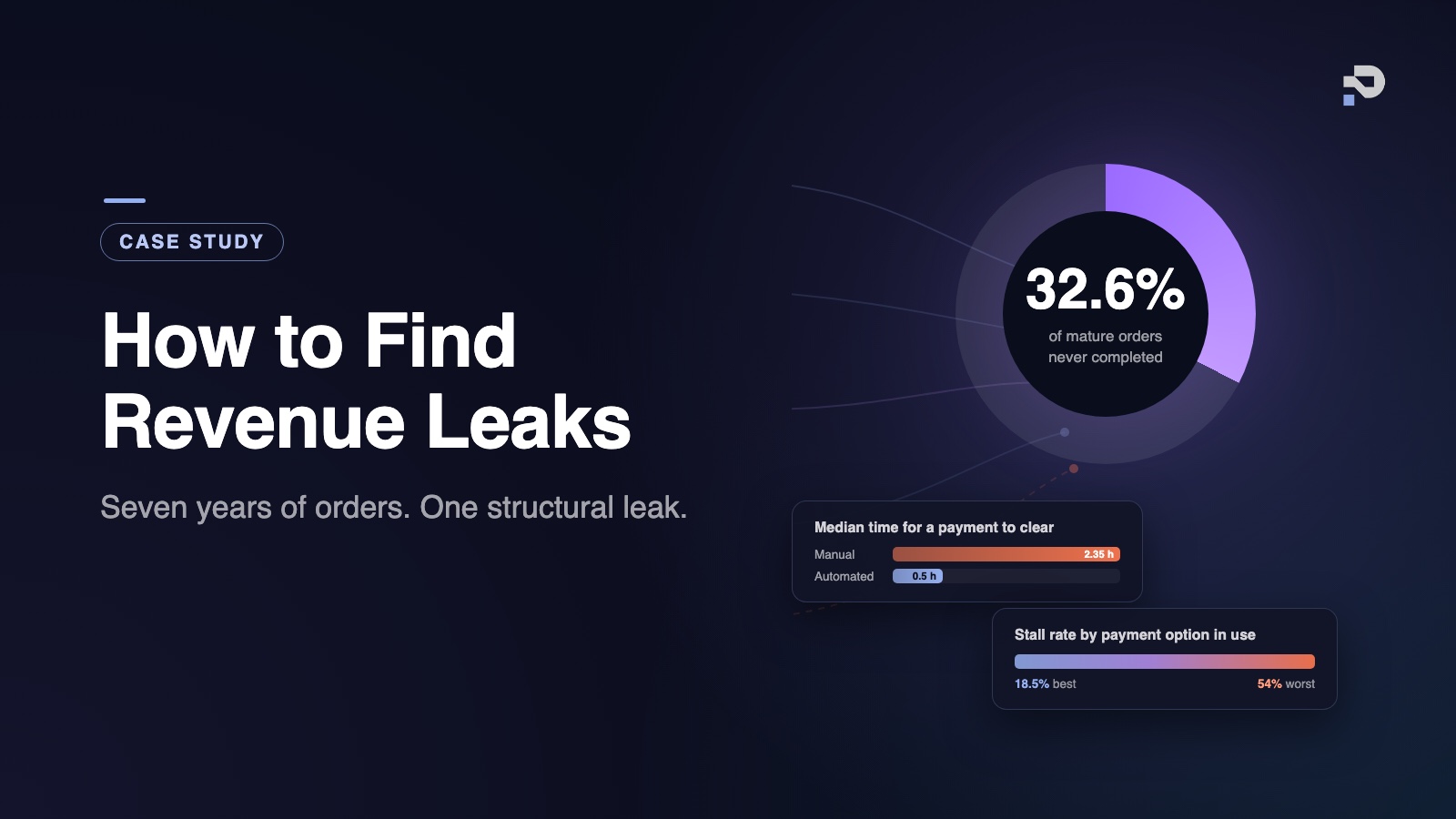
Karim Dahmani asked us to find where AI and automation would pay back in his US direct-to-consumer ecommerce business. Seven years of order data, 23,351 orders, showed a structural revenue leak he did not know he had: roughly one in three orders never completed, at the same rate through his best trading period as through the downturn. Within weeks he had shipped the two highest-priority fixes himself, working from the Blueprint, and had us design the third system down to the data model.
How Praxail is different
What we are not is as important as what we are.
Not a dev shop
We diagnose before we build. If the build is not the right answer for the business right now, we say so.
Not a chatbot vendor
We do not pitch a single tool category as the answer to an operations question. The solution follows the diagnosis.
Not Big Four transformation
Practical, scoped work with a fixed deliverable. Not a multi-year programme with large overhead and slow output.
Not a free audit funnel
The Assessment is paid because the work is real. A diagnostic with no skin in the game produces a loose list of AI ideas, not a defensible roadmap.
Not AI theatre
We do not build demos that sit unused. We build systems tied to operating metrics that leadership and teams can observe.
Specialist offer
Running a coaching or consulting business?
Praxail has a specialist offer for coaches and consultants who want to turn their framework into a done-for-you delivery arm: productized, staffed, and launched to their existing client base.
Thinking behind the work
Practical notes on AI adoption, lead conversion, and automation decisions before you spend serious money.
Start with a fit call
A 30-minute fit call to understand your business and confirm whether the Assessment will surface a credible case. Free. No commitment until scope is agreed.
Not a fan of calls?