If you run a coaching business that relies on inbound enquiries, the single biggest lever on your revenue is not your offer, your funnel, or your content. It is how fast you reply to a new lead. The data is unambiguous. 78% of buyers hire whoever responds to them first, and replying within five minutes makes you 21 times more likely to qualify the lead than replying an hour later. The average manual follow-up lag from coaching businesses we have worked with is four to six hours. That gap is where most of your pipeline quietly disappears.
AI lead follow-up for coaches is the system that closes that gap. It is not a single tool, and it is not a chatbot bolted onto a website. It is a complete pipeline that monitors every channel where leads come in, replies within minutes in your voice, qualifies the prospect, handles common objections, and presents a calendar booking link at the exact moment the lead is most likely to take it. The coach is not in the loop until there is a confirmed discovery call on the calendar.
This is a guide to what that system actually looks like, written from the engineering side of building these systems for working coaching businesses. Not a marketing overview. The components, the logic, the failure modes, and the order to build it in.
What AI lead follow-up actually means
The term "AI lead follow-up" gets used loosely. Vendors slap it on anything from a basic auto-reply to a chatbot widget. That is not what the high-leverage version of this system is.
A working AI lead follow-up system has four characteristics:
- It triggers on every lead source you care about (form submissions, DMs across platforms, replies to outreach, referrals), not just one channel.
- It responds within five minutes, every time, regardless of when the lead came in or whether you are awake.
- It does not just reply. It qualifies. It asks the questions a good salesperson would ask, in your voice, and routes the conversation toward a discovery call or a clear "not now" outcome.
- It hands the lead off to a calendar booking flow at the right moment. Not too early (you have not earned the call yet) and not too late (the lead has cooled).
If a system does any one of those four jobs and not the others, it is not a follow-up system. It is a feature. The compounding revenue impact comes from running all four together.
This matters more for coaches than for businesses generally because coaching is a high-trust, high-ticket purchase. A lead who fills out an application for a £5,000 programme is not going to wait six hours for a reply and then arrive at the discovery call still warm. They will fill out two more forms while they wait, and the first coach who replies with something thoughtful wins the call.
Why this is the highest-ROI automation in your business
Most coaches who build automation start with the wrong system. They automate content scheduling, or they build a fancy onboarding flow for clients they do not have yet. Lead follow-up is almost always the right place to start, and the numbers explain why.
Two thirds of coaches lose leads due to slow or inconsistent follow-up. Sixty seven percent, specifically, in surveys of solo coaches and small coaching businesses. The leads do not vanish. They are still on your list, in your DMs, in your inbox. The moment of intent has just passed. Re-warming a lead two days later costs an order of magnitude more effort than replying within five minutes did, and the conversion rate is materially lower.
Coaches who automate this part of their pipeline correctly report booking up to twice as many discovery calls from the same number of leads. Not from increased traffic. Not from a better offer. From not losing the leads they already had.
Run the maths on your own business. If you receive twenty enquiries a month and currently book five discovery calls from them, doubling your speed-to-lead reasonably gets you to eight or ten. If your call-to-client conversion is 40% and your average client is worth £5,000, that is between £6,000 and £10,000 of additional monthly revenue from the same top-of-funnel volume. The system that delivers this typically pays for itself in the first month.
This is also why we treat lead follow-up as the foundational system in the broader AI automation stack for coaches. The other automations (discovery call booking, onboarding, accountability) only matter if you are converting leads into the pipeline in the first place.
The five components of a working lead follow-up system
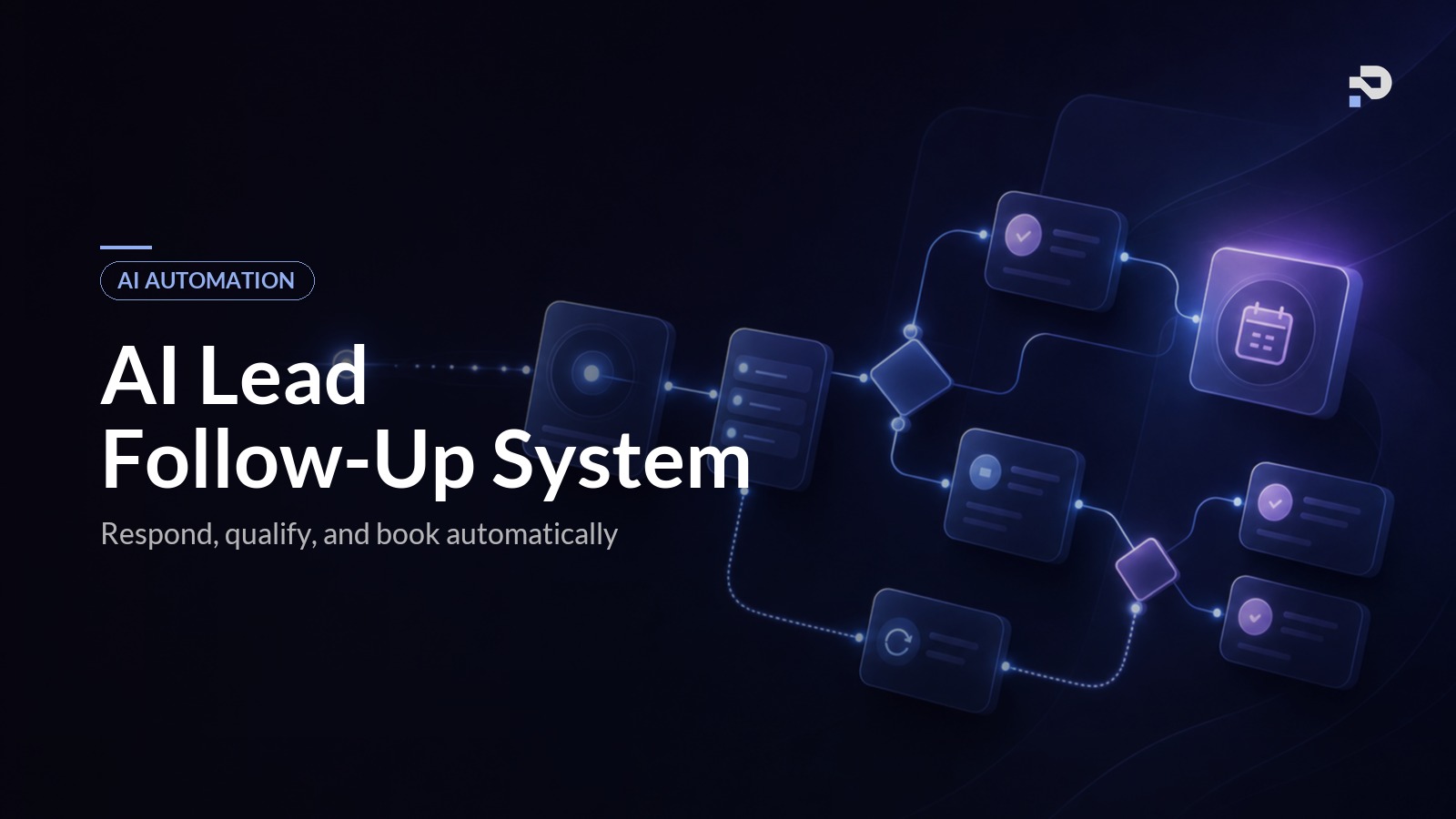
A complete AI lead follow-up system has five working parts. You can build them one at a time, but the value compounds when they run together.
1. The lead source monitor
This is the part that watches your channels and triggers everything else. Most coaching businesses have leads coming in across at least four places: a contact form, an application form, Instagram or LinkedIn DMs, and email replies to outreach or content. A few have more.
The job of the monitor is simple. Watch all of those channels, normalise the data into a single format (lead name, lead source, message content, contact details, timestamp), and pass it to the follow-up engine. If the monitor does not cover a channel, that channel is invisible to the system, and any lead who comes in through it is back to manual processing.
The technical layer is usually some combination of webhooks, polling, and platform-specific APIs. Tools like n8n, Make, or Zapier can orchestrate this, but the architectural choices matter more than the tool. We typically build this as a single ingestion node with channel-specific adapters, so adding a new lead source later is a configuration change, not a rebuild.
2. The instant response layer
The instant response is what arrives in the lead's inbox or DM within five minutes. This is the most visible part of the system, and it is also where most DIY attempts go wrong.
A good instant response does three things in one short message. It acknowledges the specific thing the lead said (not a generic "thanks for reaching out"). It provides immediate value or context relevant to their enquiry. And it asks one focused qualifying question that moves the conversation forward.
What it does not do: open with marketing copy, push a calendar link before any conversation has happened, or sound like an autoresponder. High-ticket coaching prospects can detect a generic auto-reply in two seconds, and once they have detected it, the trust the response was supposed to build is gone.
This is where AI as the underlying engine matters. A pre-written template auto-reply will fail this test. An AI-generated response, conditioned on the lead's actual message, your offer, your tone of voice, and a clear set of qualification goals, can pass this test consistently if it is built carefully.
3. The qualification flow
After the first response, the lead replies. They might answer your qualifying question. They might ask their own question. They might object on price or fit. The qualification flow is the logic that handles all of those branches.
For most coaching businesses, the qualification flow needs to determine three things before recommending a discovery call:
- Is this person actually a fit for the offer (right business stage, right problem, right willingness to invest)?
- Are they ready to talk now, or are they researching for later?
- Do they have any specific objections that should be addressed before they book the call?
Each of these can be handled with a multi-turn AI conversation if the prompt and context are constructed properly. The prompt should include your ideal client profile, the deal-breakers, your tone of voice, and a clear instruction to surface any uncertainty rather than push for a booking. A coach's time on a call with a misfit prospect is the most expensive resource in the business, so the cost of a system that books unqualified calls is high.
4. The booking handoff
This is the moment the system asks the lead to take the call. The timing of this is more important than the wording.
Asked too early, before the lead has voiced their problem and felt heard, the booking link feels presumptuous and pushy. Asked too late, after three or four rounds of qualification, the lead has had time to cool down and second-guess themselves. The right moment is when the lead has expressed a clear problem, the AI has confirmed the offer is a good fit for that problem, and the natural next step is "let us talk about it properly."
The booking handoff itself is best done with a personalised message that names what the call will cover, sets a realistic expectation of what will happen on the call, and provides a calendar link that defaults to suitable time slots. The link should pre-fill what the system already knows about the lead, so the booking form takes thirty seconds, not five minutes. Friction at this step costs bookings.
5. The fallback and re-engagement layer
Not every lead replies on day one. Some take three days. Some take three weeks. Some never respond again. The fallback layer is what runs in the background to recover as much of that pipeline as possible without crossing into spam.
A reasonable fallback sequence for a high-ticket coaching offer looks like this:
- Day 2 (no reply): a short check-in message that adds value rather than nagging, usually a relevant resource or a soft question.
- Day 5 (still no reply): one more touch, repositioned around a different angle the lead might care about.
- Day 14 (still no reply): a clean breakup message that closes the loop and invites the lead to reach out when timing improves.
If the lead replies at any point, the sequence stops automatically and they re-enter the qualification flow. If they never reply, the system tags them as cold and stops messaging them. Both outcomes are explicit. The system does not silently accumulate ghost leads.
How the full system runs end-to-end
When all five components are in place, a single lead's journey looks like this.
- Lead submits a form on your site at 22:14 on a Tuesday evening. The monitor detects it within seconds and passes the lead data to the follow-up engine.
- By 22:18, the lead has received a personalised message that acknowledges their specific enquiry, gives a useful piece of context, and asks one qualifying question.
- The lead replies at 09:40 the next morning. The qualification flow processes the reply, determines the lead is a fit, and asks one more clarifying question.
- The lead answers within twenty minutes. The system has now confirmed fit, surfaced the lead's main objection (they are worried about time commitment), and addressed it briefly with a relevant data point.
- The system offers the discovery call: "Want to jump on a 30-minute call this week to talk through whether this is a fit? Here is my calendar." The lead clicks the link and books a slot for Thursday afternoon.
- The discovery call automation system takes over. Confirmation email, calendar invite, pre-call preparation materials, and reminders the day before and the morning of the call.
Total coach involvement so far: zero. The first time the coach hears about this lead is the calendar notification on Thursday morning, with the prospect already prepped and primed for the conversation.
That sequence runs the same way for every lead, every channel, around the clock. The compounding effect on bookings is what makes this the most consequential automation in the business.
Best practices that separate working systems from broken ones
After building these systems for several coaching businesses, a clear pattern emerges between the ones that compound revenue and the ones that quietly fail. Here is what differentiates them.
Voice fidelity is non-negotiable
If your AI response sounds like ChatGPT, the system is working against you. Your voice is your differentiator, and a generic AI tone is the fastest way to commoditise your brand. The way to fix this is to put real examples of your writing into the prompt. Short examples, specific to the channel, covering different scenarios. Then test the output against messages you would actually send.
We typically iterate on voice prompts for a few rounds at the start of every build, with the coach reviewing real outputs against their own writing until the system passes a blind test. Skipping this step produces a system that books calls but damages the brand.
Qualification needs explicit deal-breakers
The qualification logic should be as clear about who to filter out as it is about who to filter in. Otherwise the AI will optimise for engagement rather than fit, and you will end up with a calendar full of warm-but-wrong calls.
The deal-breakers for a high-ticket coaching offer are usually some combination of business stage (too early), budget signals, problem fit, and timing. These should be explicit in the prompt, with instructions to politely redirect or close the conversation rather than push for a booking when one of them surfaces.
The system needs a human escape hatch
Every working system has a clear path for the coach to step in. A "this needs your attention" flag for edge cases, a way to take over a conversation mid-flow, and an audit log of every message sent on the coach's behalf. Without these, the system is a black box, and black-box systems break trust the first time they say something the coach would not have.
The audit log specifically matters for the moment when a coach reads a thread and thinks "did the system really say that?" Being able to see exactly what was sent, when, and why, is what makes coaches comfortable letting the system run.
Speed matters more than perfection
A response that arrives in three minutes and is 80% as good as the perfect response will outperform a 100% perfect response that arrives in three hours. The data is consistent on this. Optimise for speed first, then quality. That said, quality must still be high enough to pass the brand bar. A fast reply that sounds like spam is worse than no reply at all.
The technical layer: what these systems are built on
The technical stack for AI lead follow-up is less interesting than the logic, but it is worth being honest about what it takes.
For the orchestration layer, we typically use n8n. It is open source, self-hostable, has the depth needed for production-grade error handling, and the visual layer makes the logic auditable. Make and Zapier can both work for simpler builds, but they hit ceilings on cost and complexity faster than n8n does for systems with this many branches.
For the AI layer, the model choice depends on the channel and the criticality. For instant responses where latency and cost matter, we typically use GPT-4o or Claude Sonnet. For more complex qualification reasoning where accuracy matters more than speed, we sometimes use a more capable model on the critical decision points.
For the channel adapters, the picture is more fragmented. Email is straightforward. SMS is straightforward. Instagram and LinkedIn DMs require either platform APIs (where they exist), official integrations, or, in some cases, careful workarounds that respect platform terms of service. Each channel has its own constraints, and the build needs to account for them.
For the calendar booking, Calendly, Cal.com, and similar tools handle this well. The integration matters more than the tool. The booking link needs to be context-aware, the confirmation needs to flow back to the system, and the data needs to populate downstream systems automatically.
The point of listing this is not to recommend a specific stack. It is to make clear that a production-grade lead follow-up system is not a no-code afternoon project. The logic is genuinely complex, and the failure modes (a webhook drops, an API rate-limits, a model returns malformed output) all need explicit handling. Cutting corners here produces a system that works in the demo and fails in week three.
Common mistakes that kill these systems
Across builds, these are the failure modes that come up most often.
Building before the manual process is solid
If your manual lead follow-up process is unclear (you are not sure when you reply, what you say, when you push for the call, when you let it cool), automating it produces a faster, more consistent version of the same confusion. Define the manual process properly first. Write down the actual messages you would send at each stage. Then automate that.
Treating the AI as a black box
The temptation is to write one big prompt and trust the model to do the rest. This works in demos and fails in production. Each step in the qualification flow should be a clearly defined task with a defined output, not a single open-ended conversation. Modular prompts with structured outputs are the difference between a system that scales and one that drifts.
Skipping the audit log
If you cannot see exactly what was said on your behalf, you cannot trust the system. Build the audit log into the foundation of the system, not as an afterthought. Every message sent, every decision made, every fallback triggered: logged, searchable, reviewable.
Over-relying on volume metrics
Booked calls is a useful metric. So is response rate. But the metric that actually predicts revenue is qualified-call-to-client conversion, and that is downstream of how well the qualification flow is doing its job. Tune the system on the right metric and you build a system that prints money. Tune it on the wrong one and you build a calendar full of bad calls.
Forgetting that platforms change
Channel APIs change. Platform terms of service change. The integration that worked perfectly in February breaks in May because Meta updated something. Production systems need monitoring, ongoing maintenance, and a relationship with whoever built the system that does not end at handover. This is one of the reasons we build with a long maintenance window into every engagement.
How to build this in your business
The decision is mostly about what stage you are at.
If you are getting fewer than ten leads a month, the honest advice is that you do not need this system yet. Reply manually, learn what your leads actually ask, what they object to, and what makes them book. The system you eventually build will be much better for being grounded in real conversations rather than guesses.
If you are getting ten to forty leads a month and you are losing some of them to slow follow-up, this is the system that matters most. The ROI is direct, the build is well-defined, and the work pays for itself quickly. Whether you build it yourself with a long ramp-up, or have it built and handed over, both are reasonable depending on your appetite for technical work.
If you are getting more than forty leads a month and you are not running a system like this, you are leaving significant revenue on the table. At that volume, the difference between a manual process and an automated one is usually six figures of annual pipeline.
A complete AI lead follow-up system, including all five components, typically takes two to three weeks to build properly, another week of testing and calibration with real leads, and ongoing iteration as the system meets edge cases in production. We have shipped versions of this for coaching businesses that produce the kind of metrics quoted at the start of this guide. The pattern is repeatable, but the details matter, and the details are where most generic builds fail.
FAQ
What is AI lead follow-up for coaches?
It is a system that automatically replies to new leads within minutes, qualifies them in a multi-turn conversation that uses the coach's voice, handles common objections, and books a discovery call when the lead is qualified and ready. The coach is not involved until the call is on the calendar.
How fast should a coach reply to a new lead?
Within five minutes whenever possible. Replying within five minutes makes you 21 times more likely to qualify the lead than replying after an hour, and 78% of buyers hire whoever replies first. Outside of that window, conversion rates fall sharply.
Will an AI follow-up sound impersonal to high-ticket coaching prospects?
It can, if the system is built poorly. A generic AI reply is worse than no reply for a high-ticket offer. A well-built system, with the coach's voice in the prompt, examples of the coach's actual writing, and clear qualification logic, can pass a blind test against the coach's manual responses. Voice fidelity is the single most important quality bar for these systems.
Can I build this with no-code tools?
Partially. Tools like n8n, Make, and Zapier can orchestrate the workflow. The AI layer plugs in via standard APIs. What no-code does not handle well is the logic complexity of a multi-step qualification flow, the error handling needed for production reliability, and the channel-specific quirks of each lead source. The no-code build will look like the production build for the first ten leads and diverge sharply after that.
How much of the qualification can the AI actually do?
Most of it, for high-ticket coaching offers. The AI can confirm fit, surface objections, address the common ones, and identify the leads that need a human conversation. What it should not do is push past a clear "no" or fabricate confidence about fit. Properly built, the AI will hand off ambiguous cases to the coach with full context attached.
What does this cost to run?
The variable cost is usually low. Model API calls, channel API costs, calendar tool subscription. For a coaching business handling fewer than 200 leads a month, the operational cost is typically in the £30 to £100 range per month. The build cost is the larger investment, and varies depending on whether you build it yourself or have it done by a team that ships these systems regularly.
How is this different from a chatbot on my website?
A chatbot answers questions on the page someone is currently looking at. A lead follow-up system does the work after the lead has left the page. When they are checking their inbox at 23:00 the same evening. When they are deciding which of three coaches to book a call with. When they have not replied in three days and are about to forget you exist. Chatbots optimise for the moment of attention. Lead follow-up systems optimise for the moments after.
If you want to see how this kind of system is actually built (the logic, the components, the metrics from a working build), our case studies page shows the systems we have shipped for working coaching and services businesses. If you would rather have one built for you, get in touch and we can walk you through what a build looks like before you commit to anything.